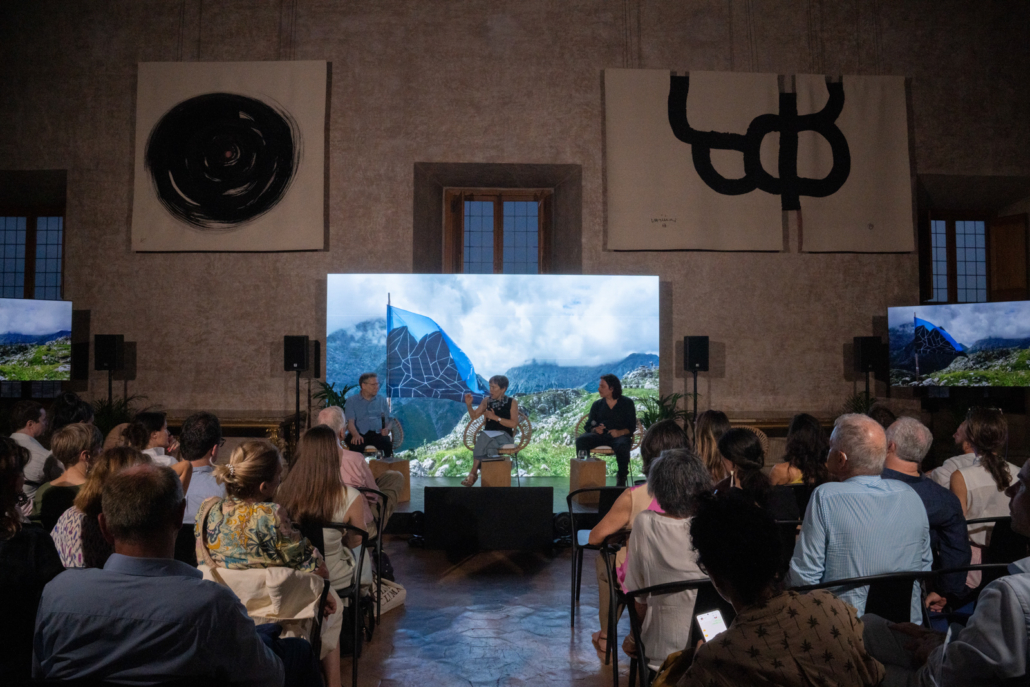
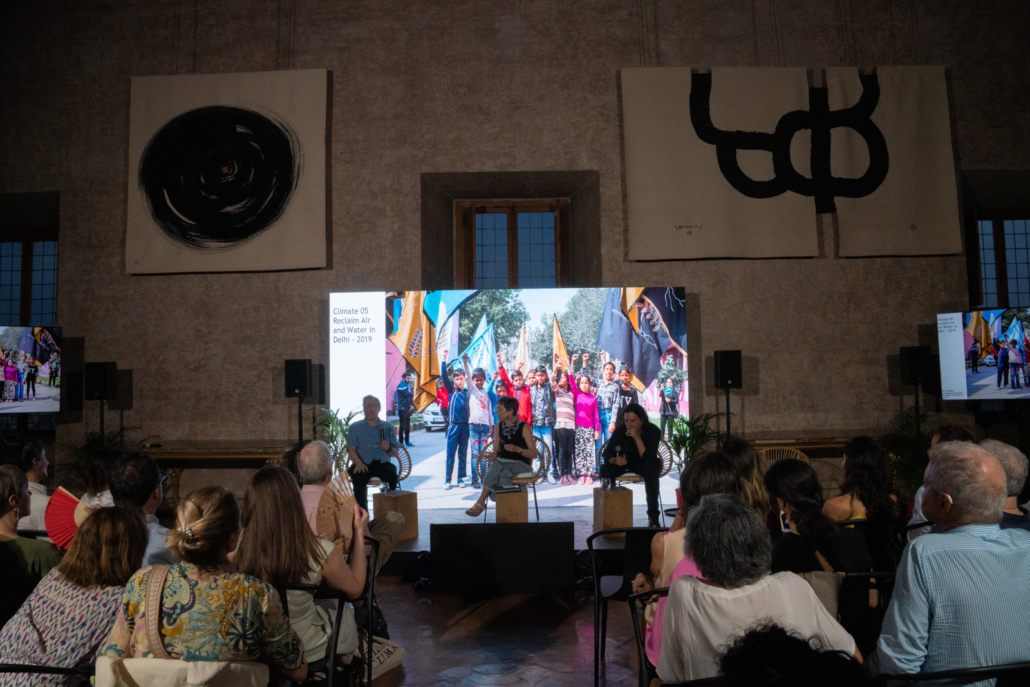
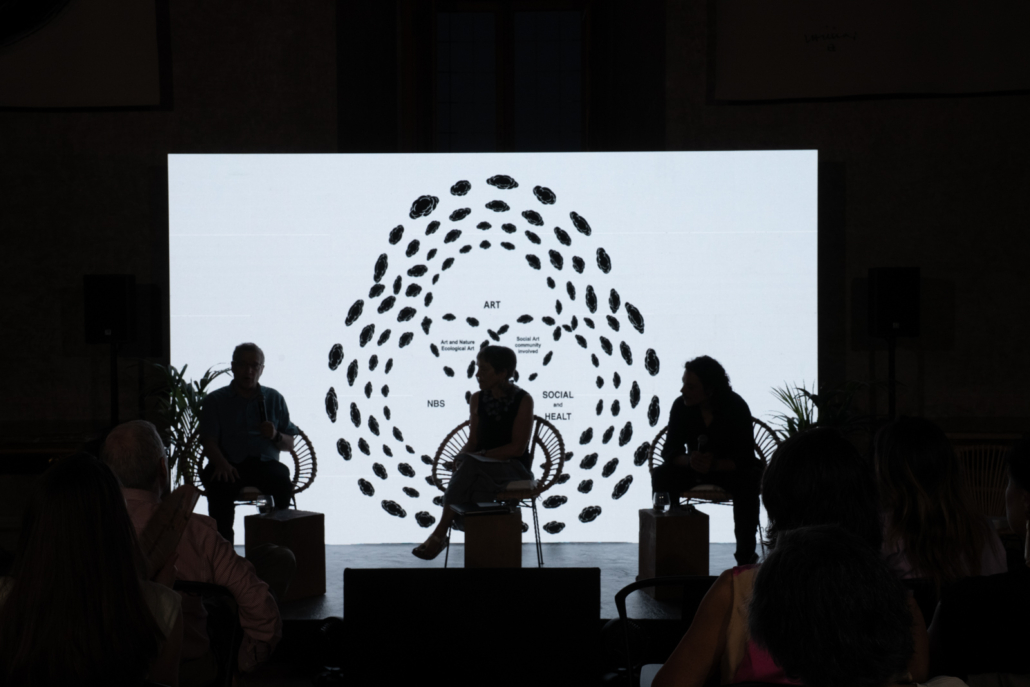
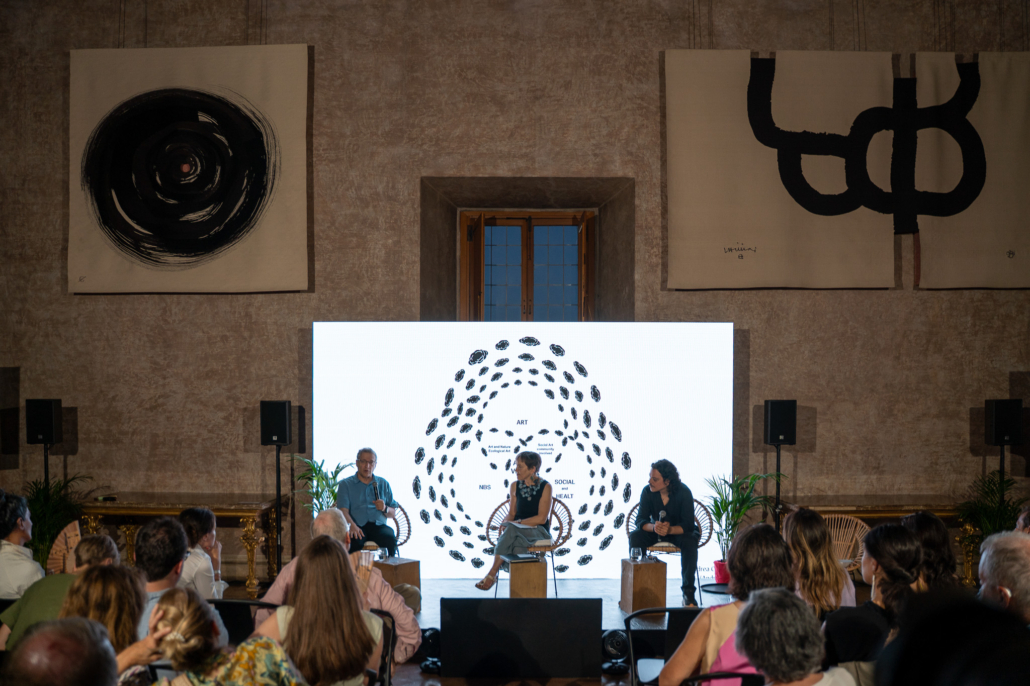
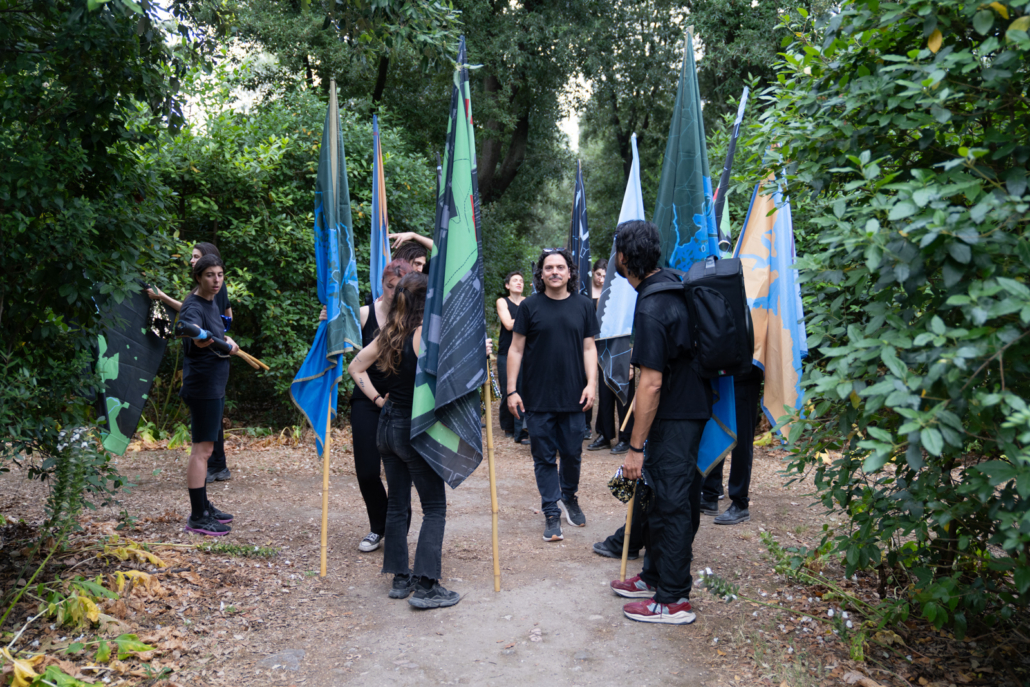
The Performance: A Ritual of Ecocentric Transformation
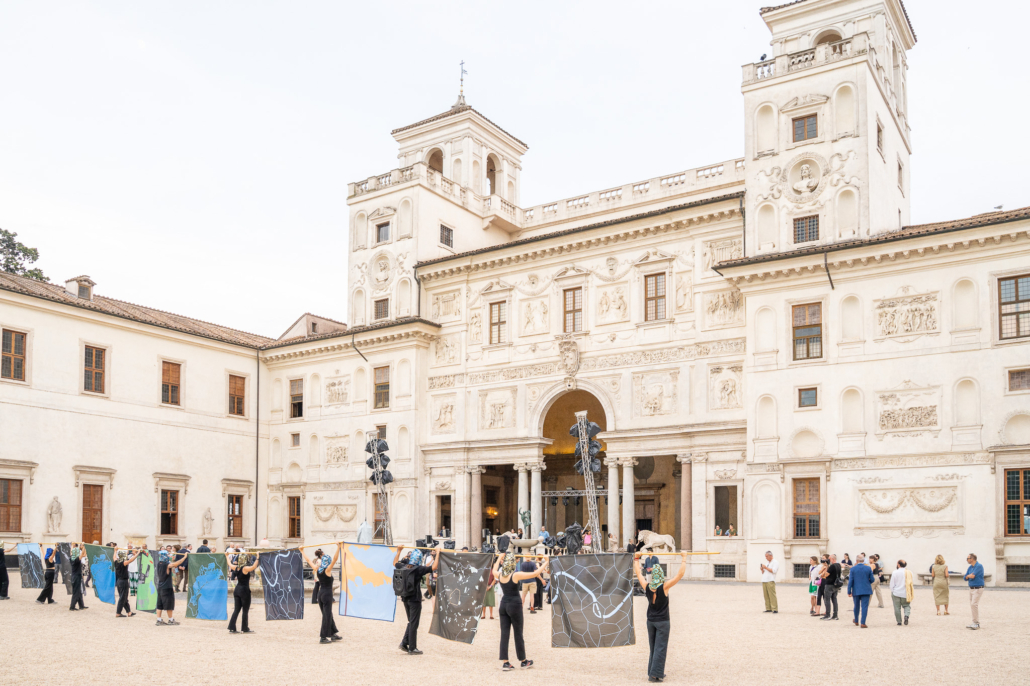
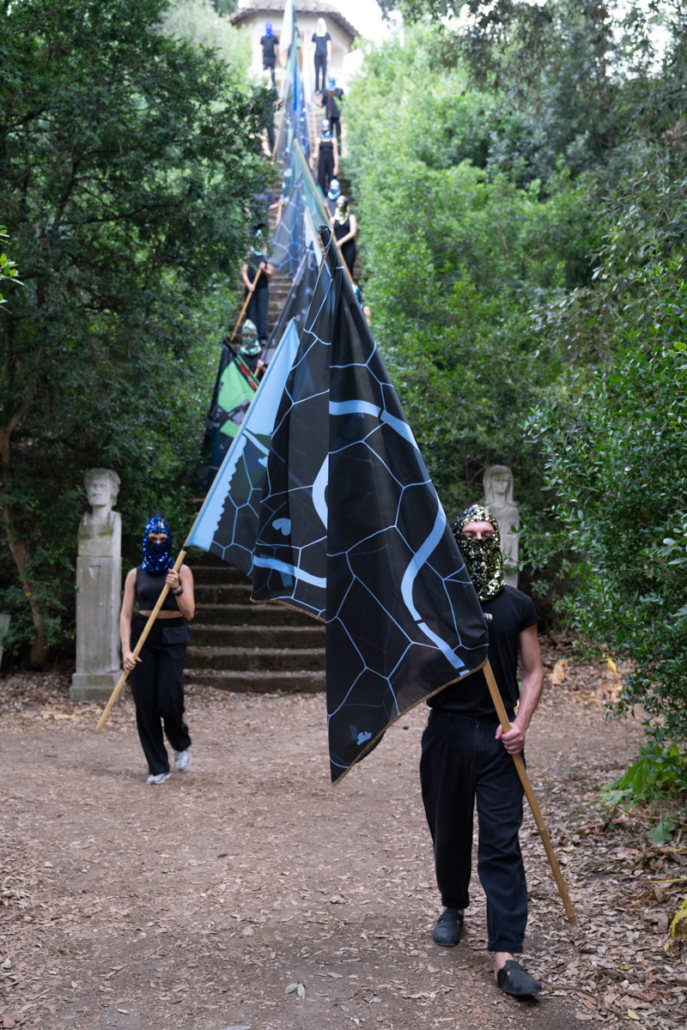
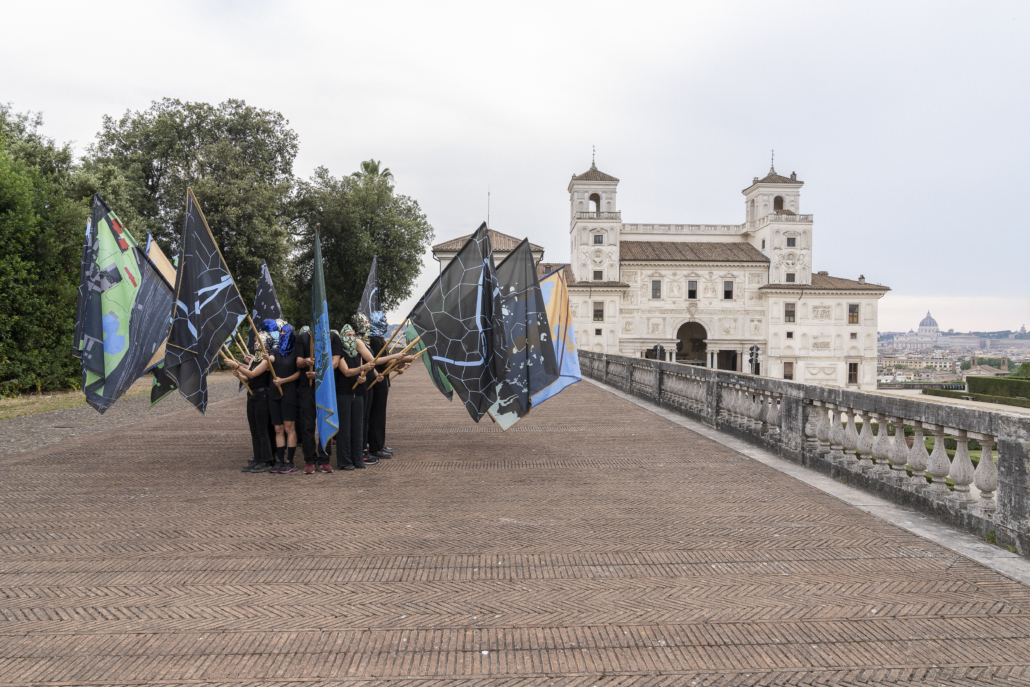
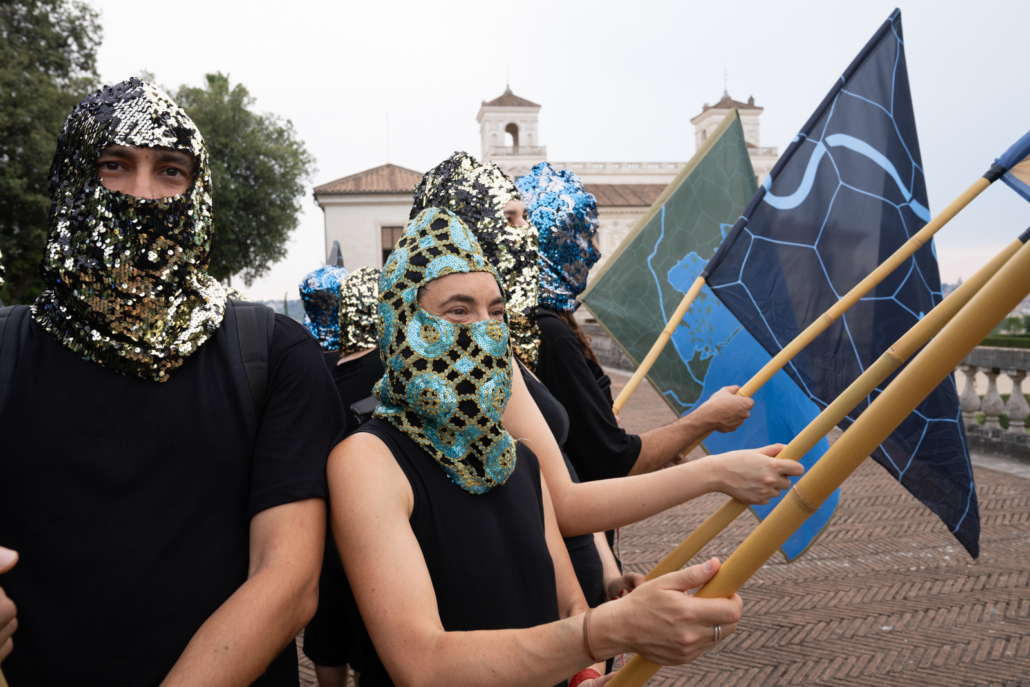
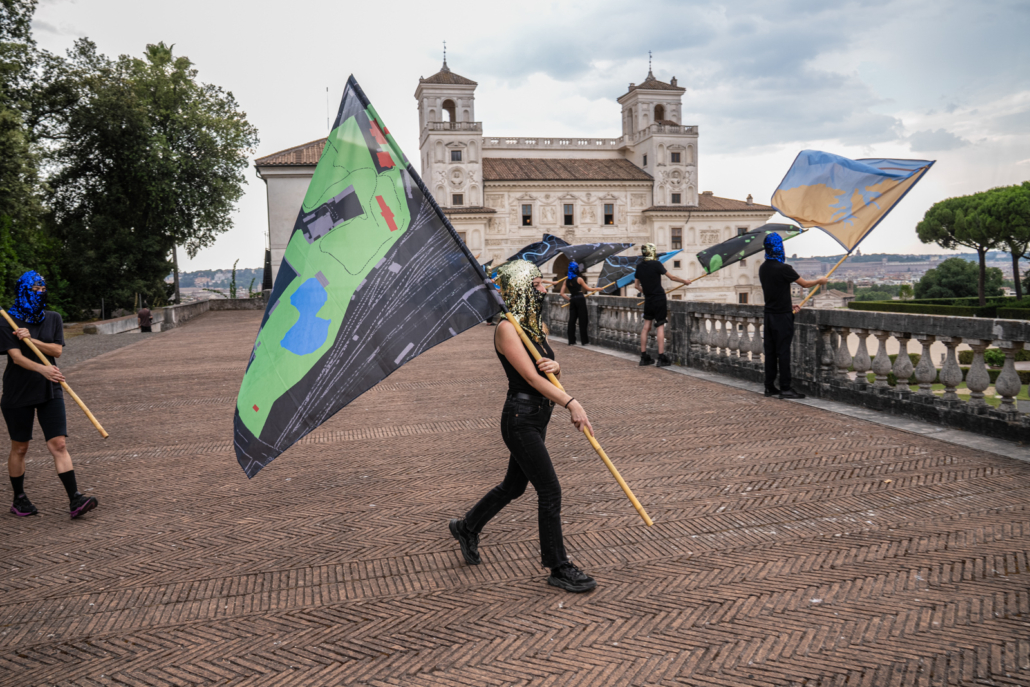
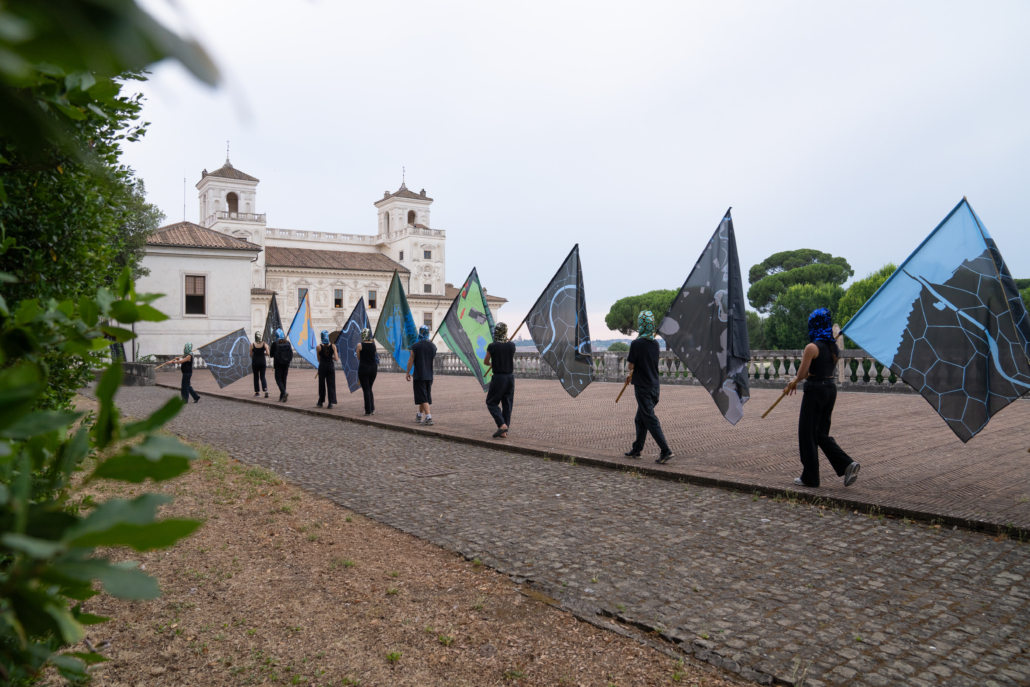
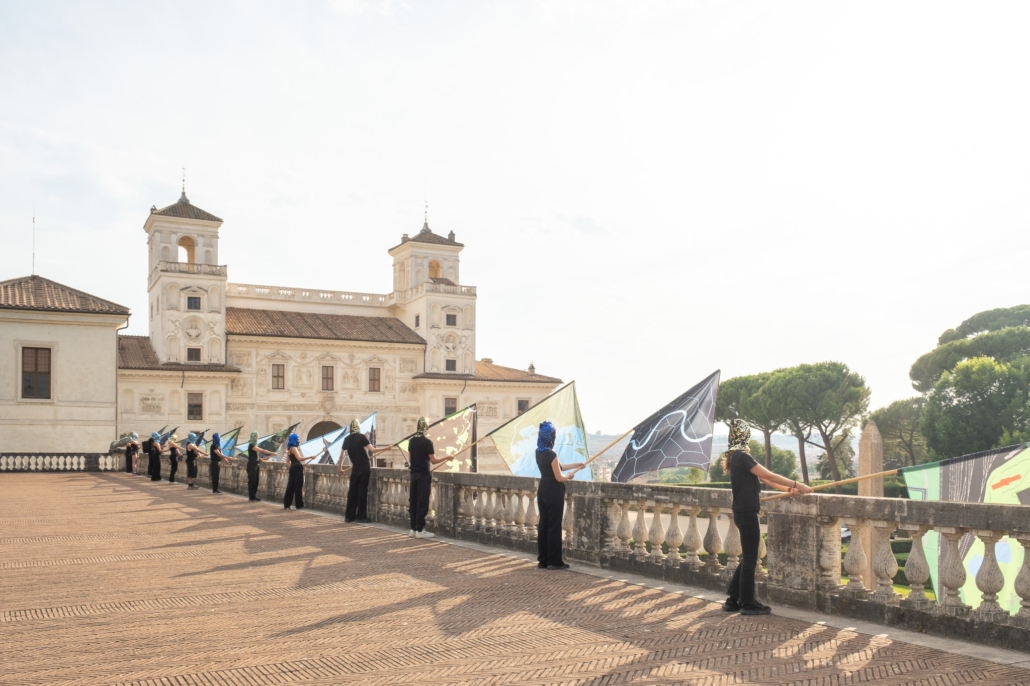
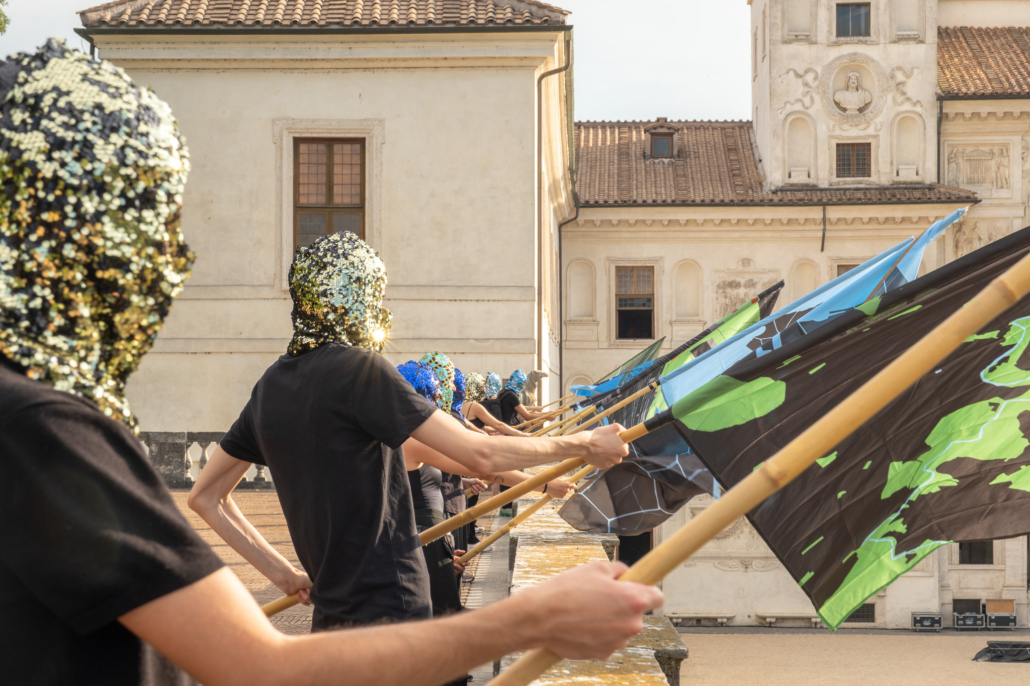
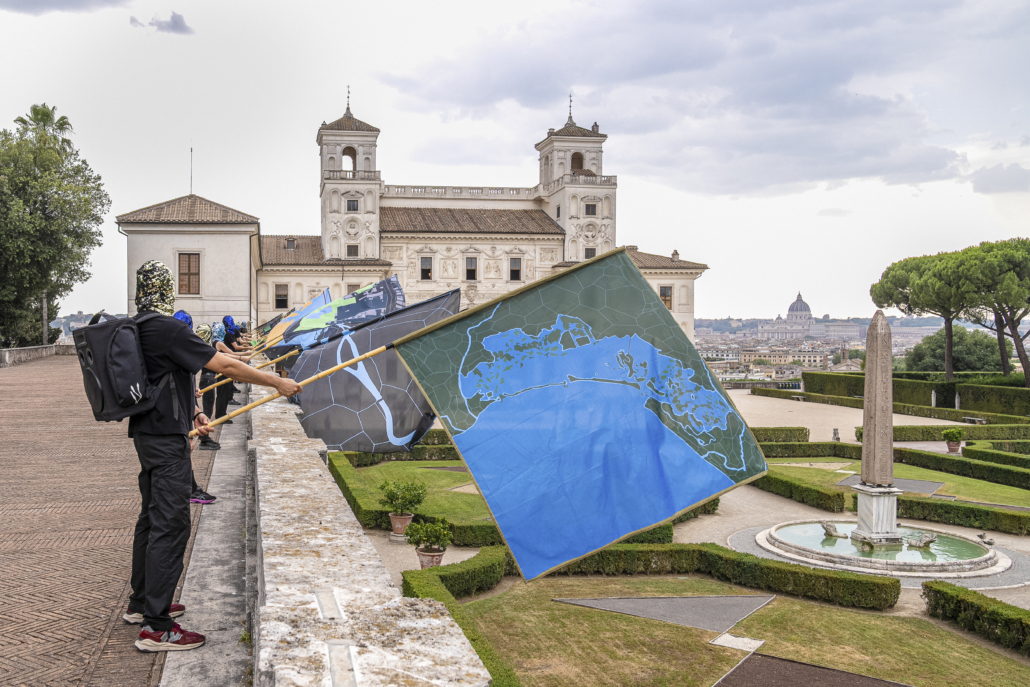
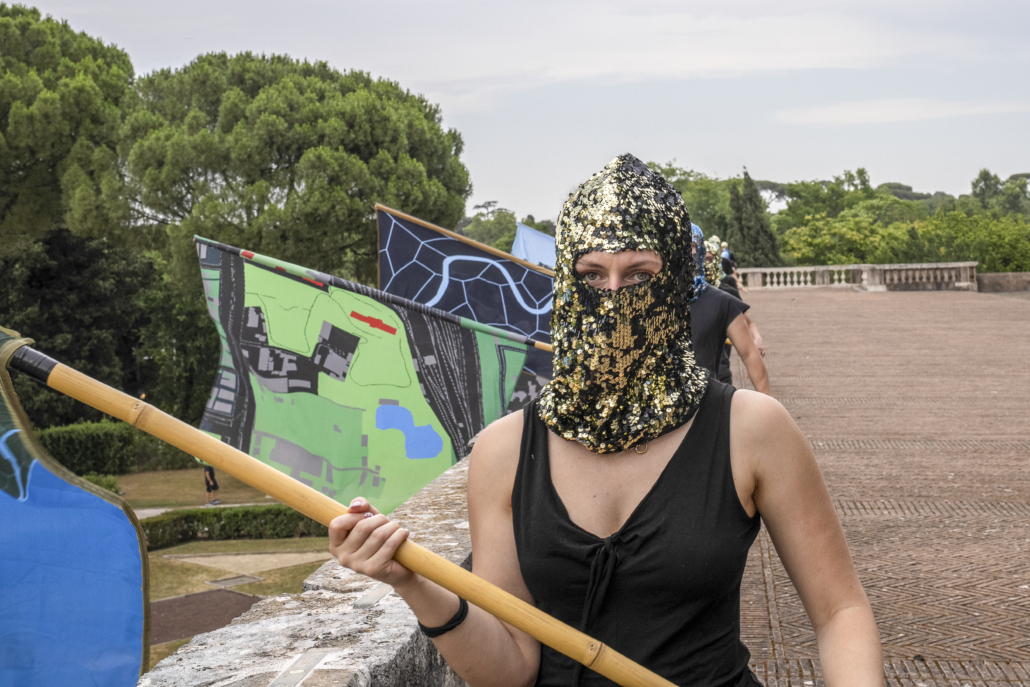
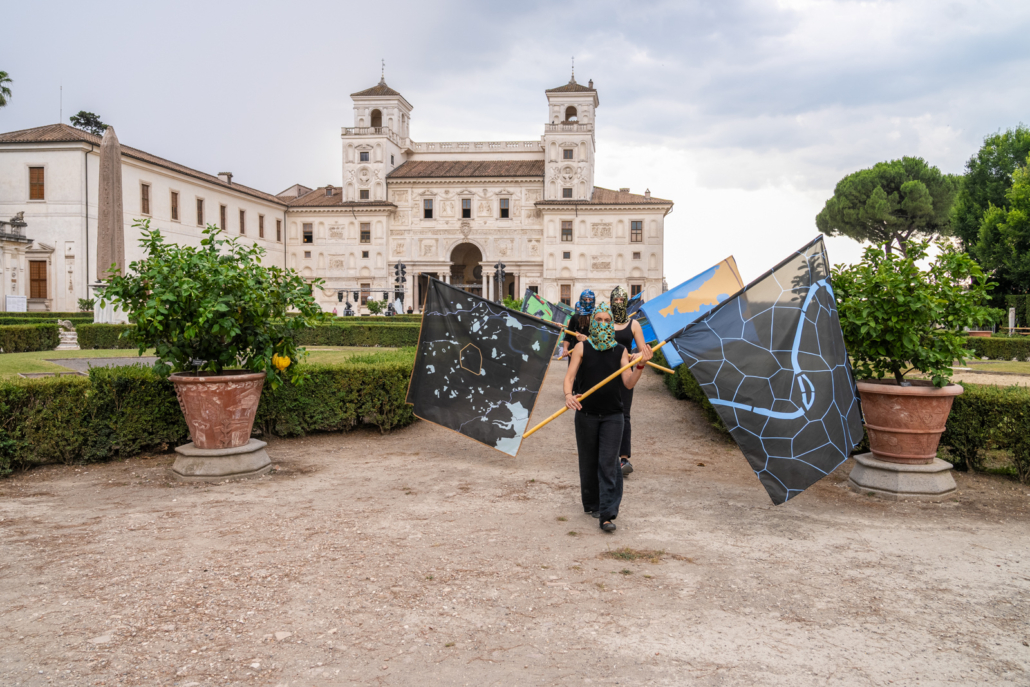
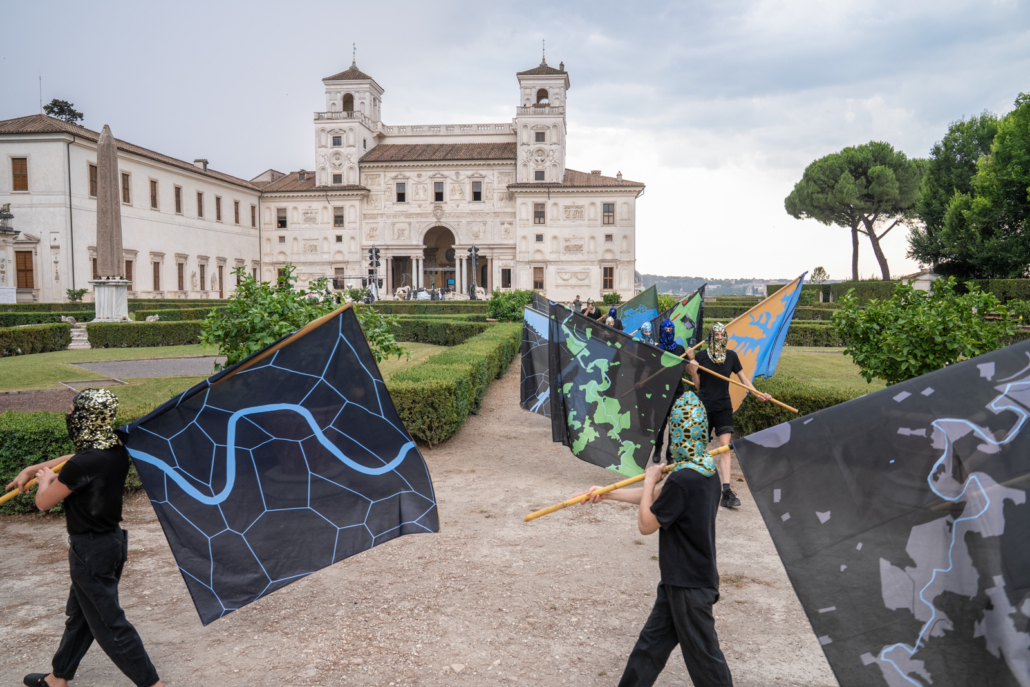
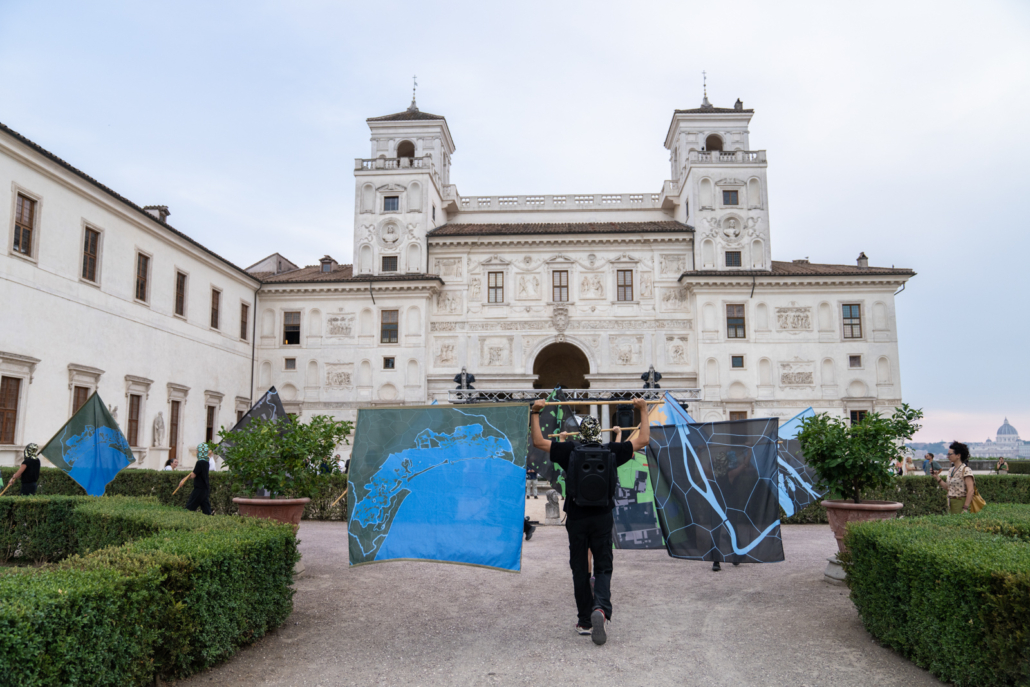
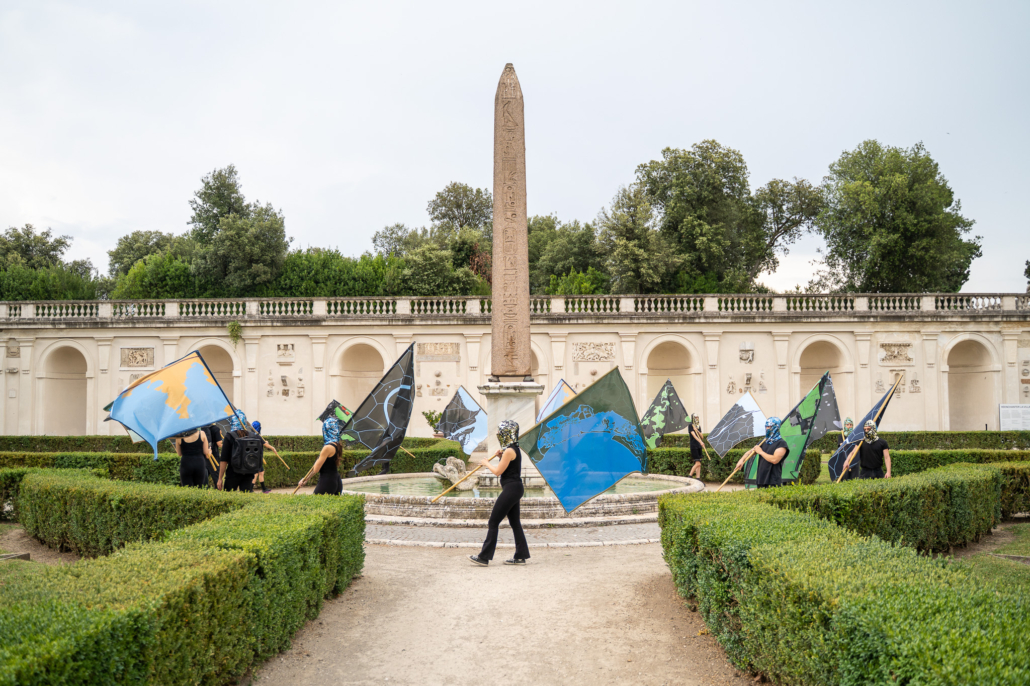
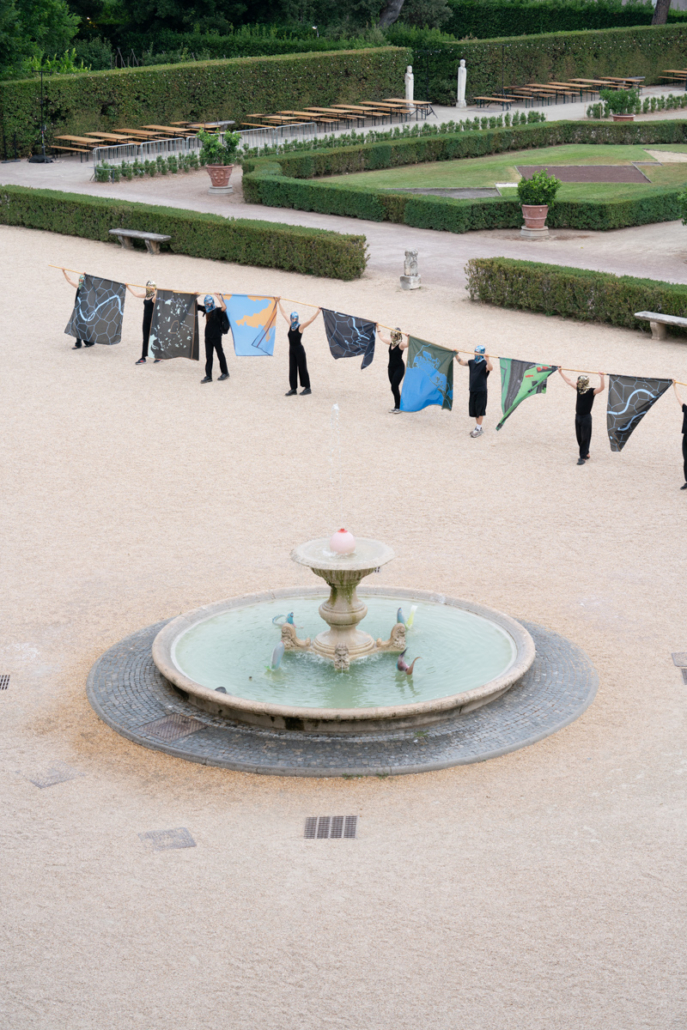
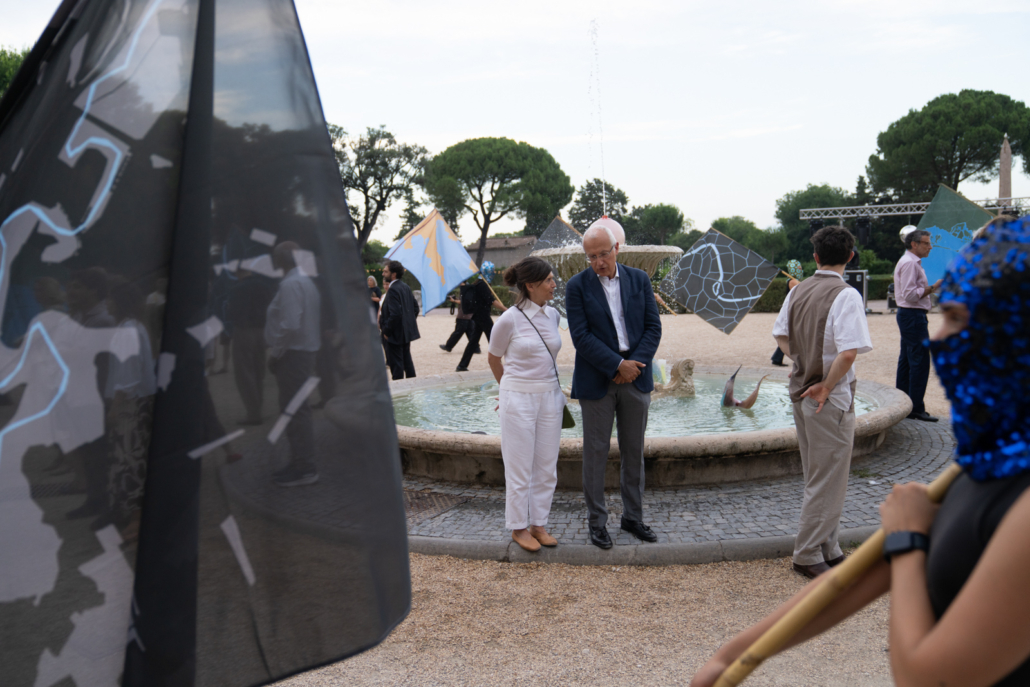
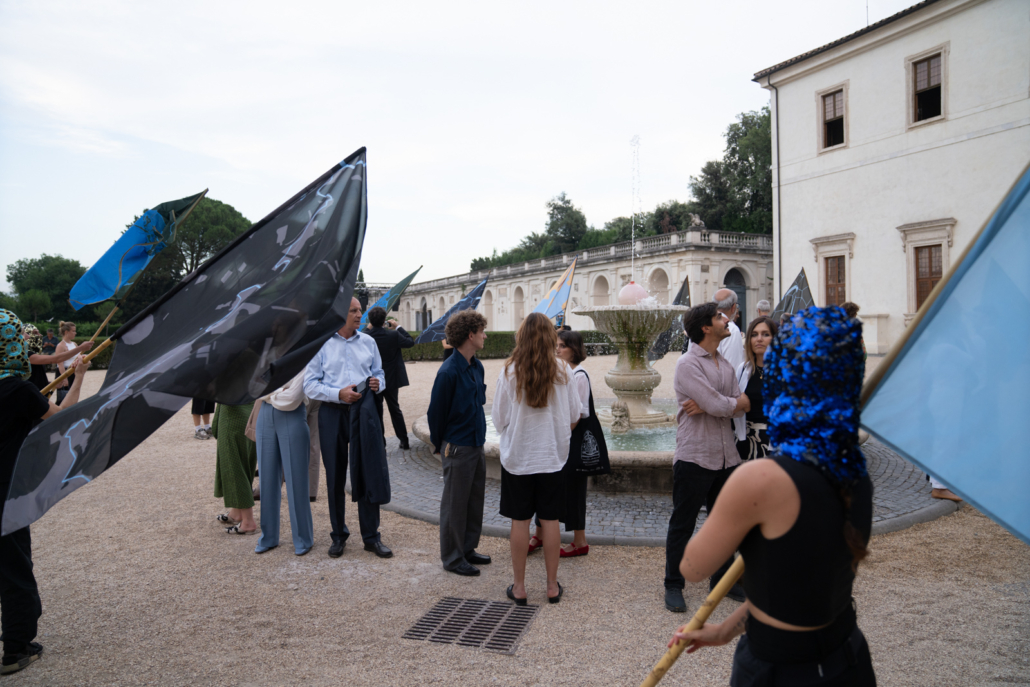
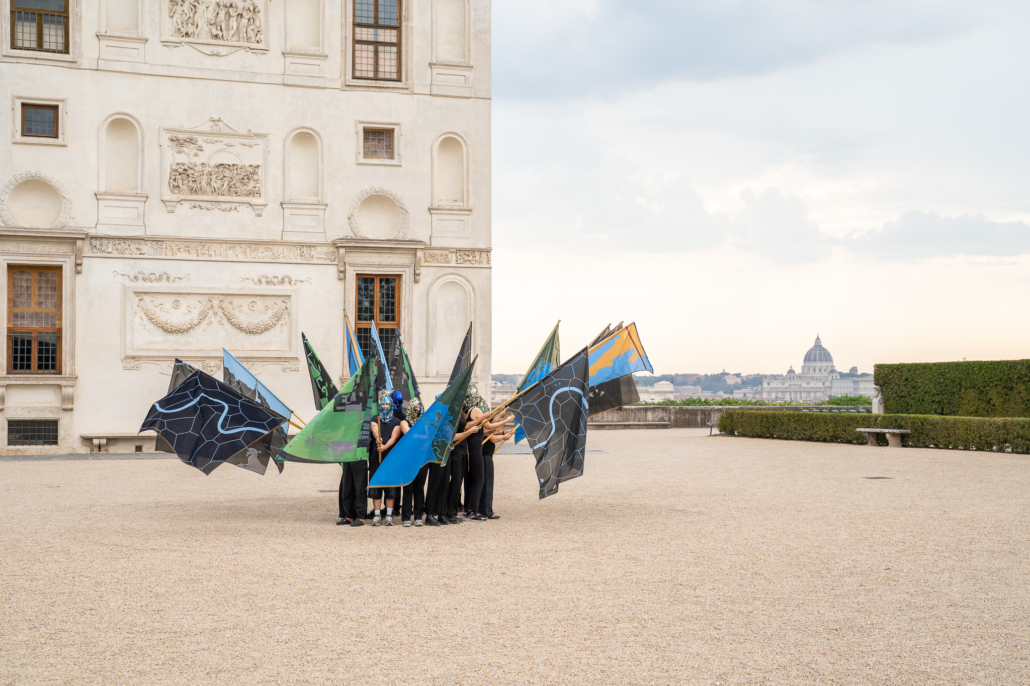
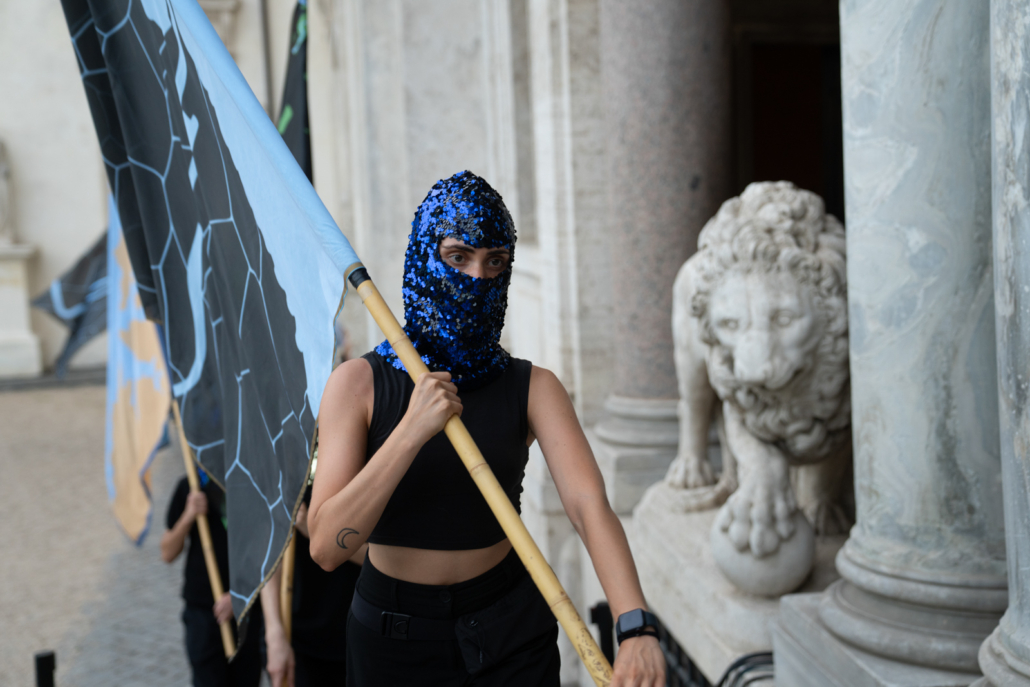
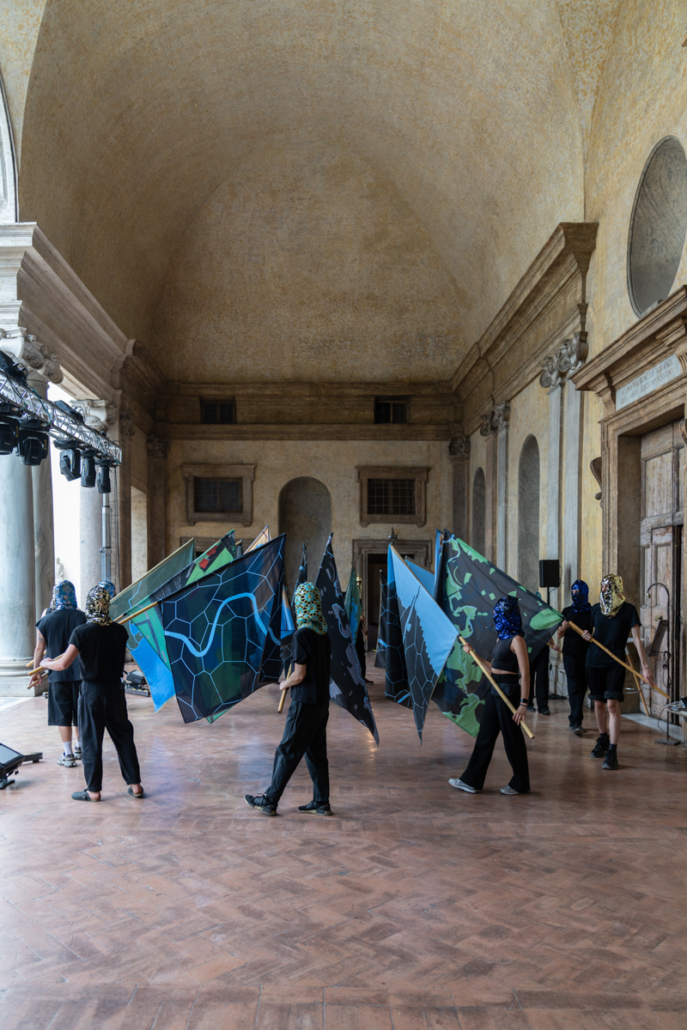
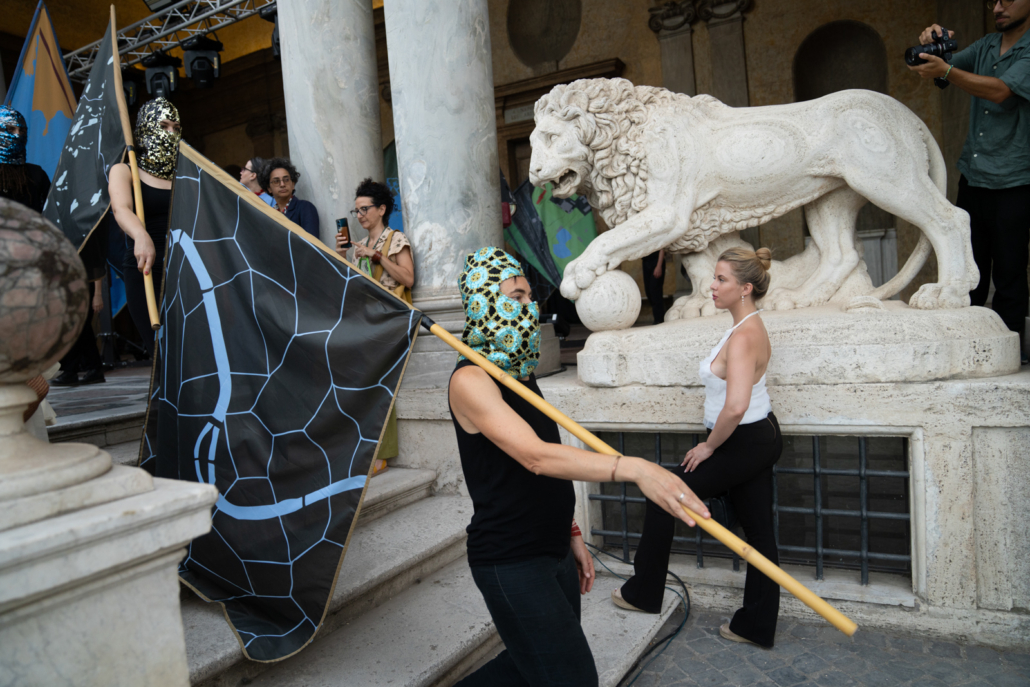
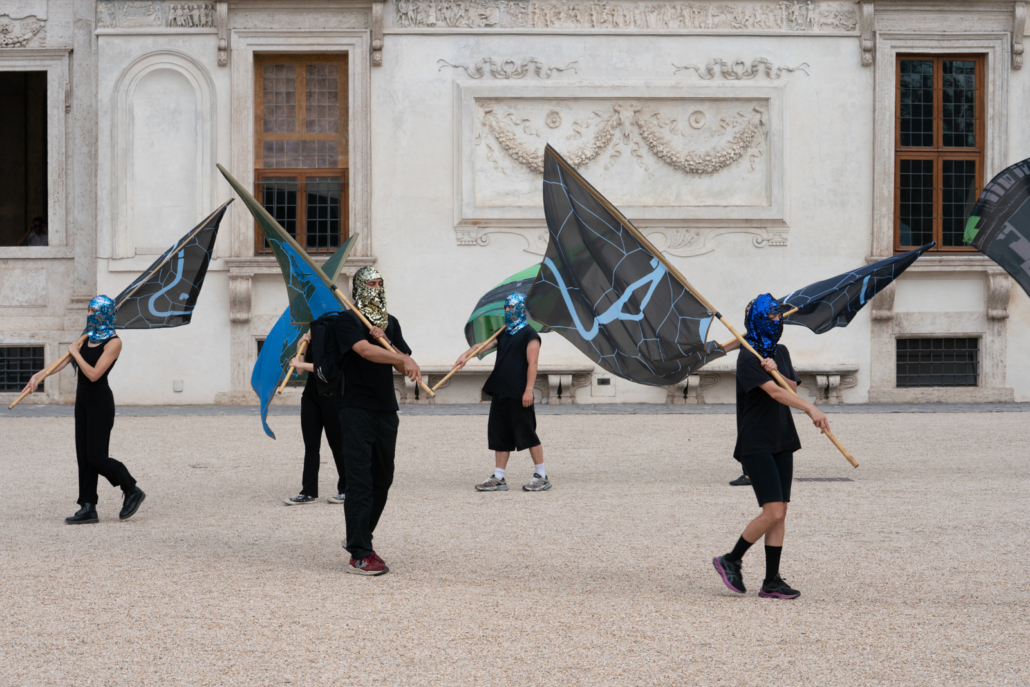
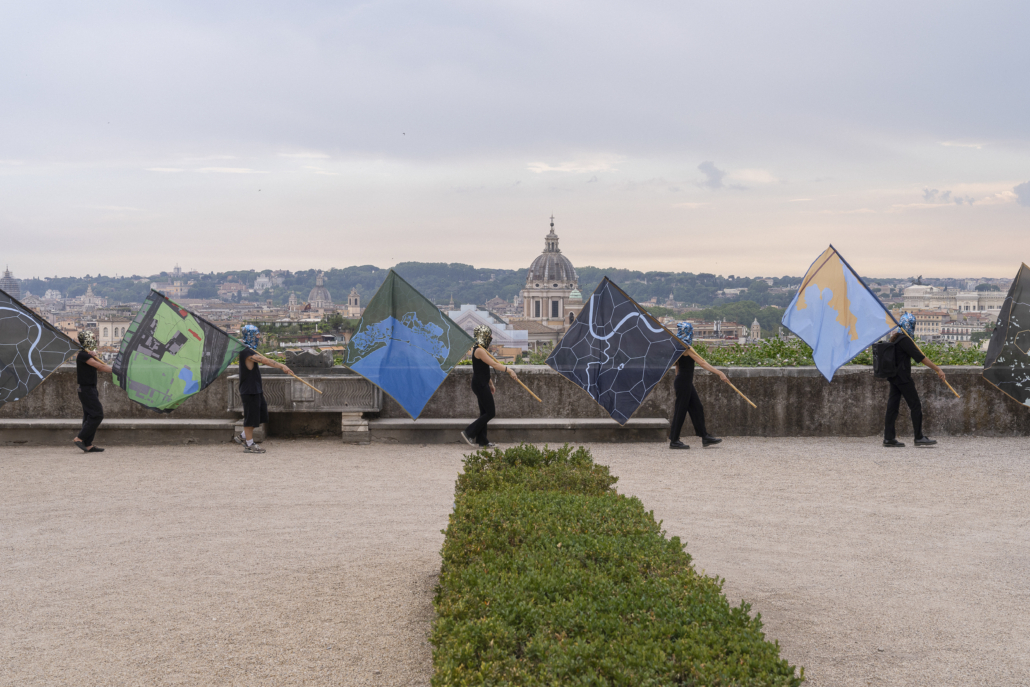
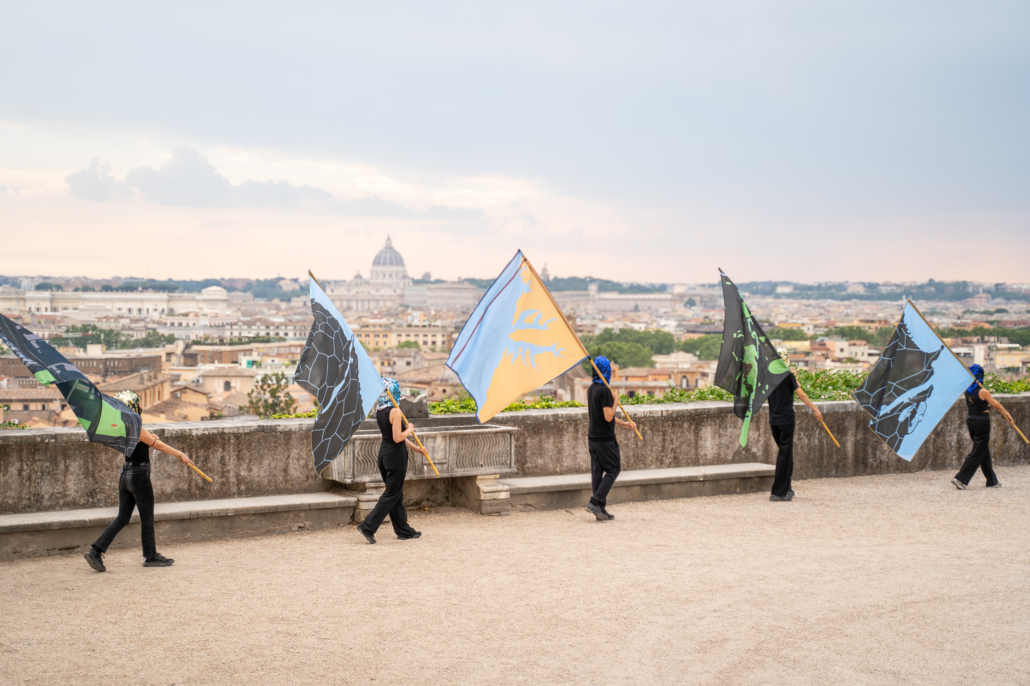
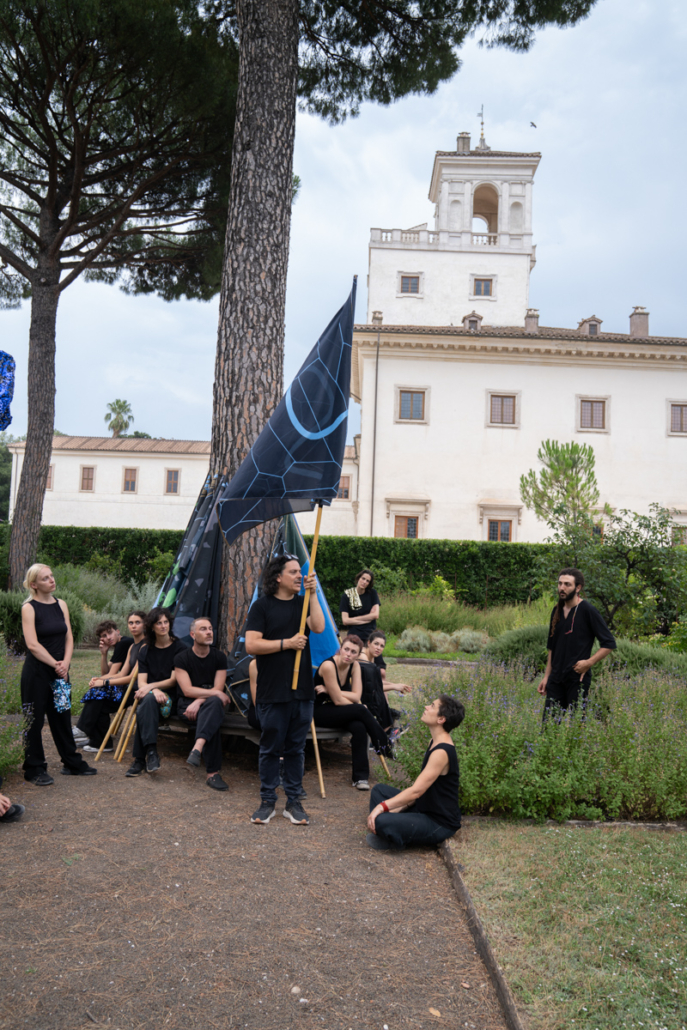
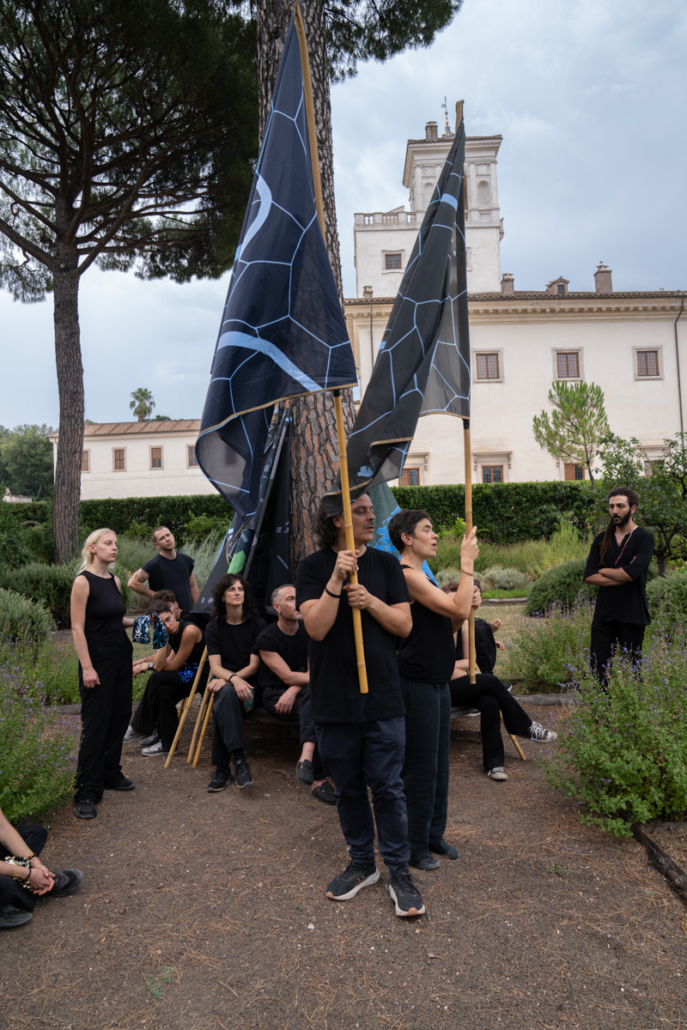
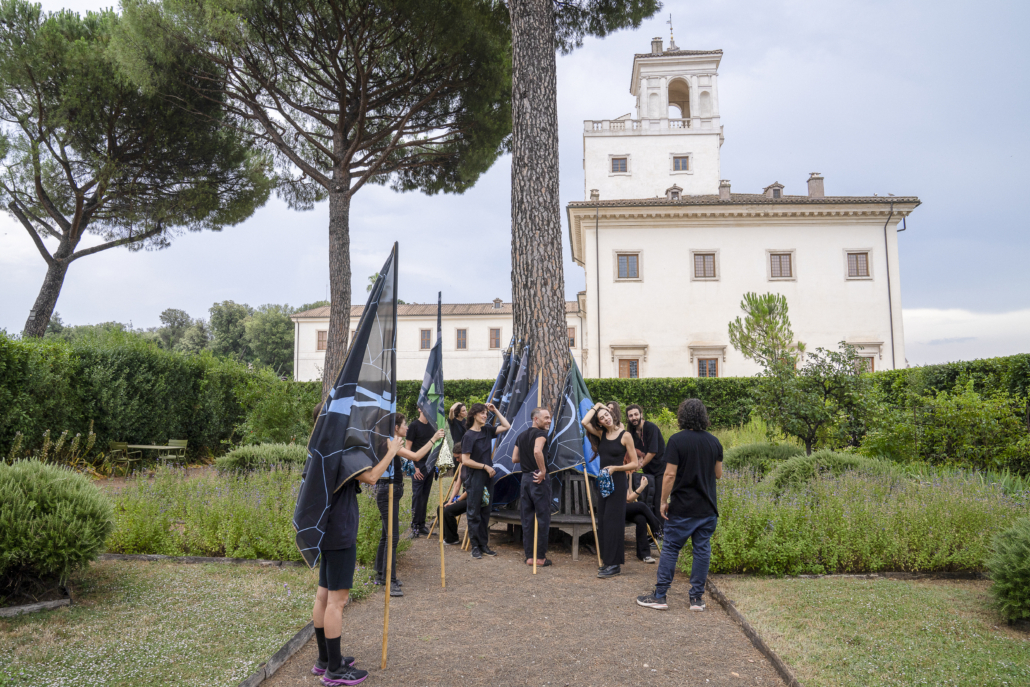
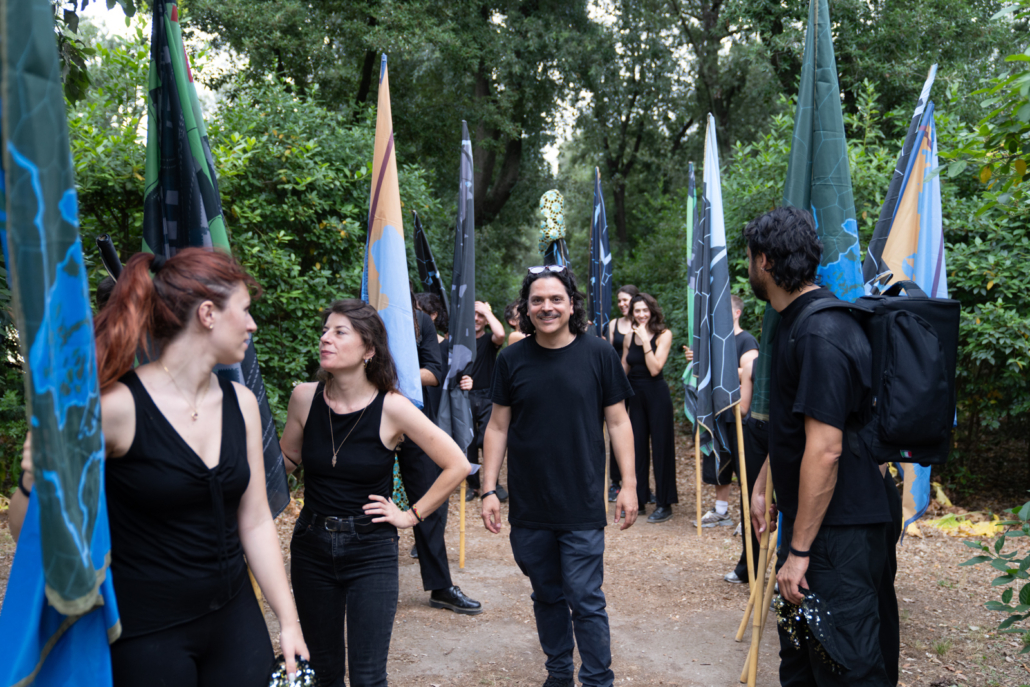
The performance unfolds as a ritual procession through the landscape and architecture of Villa Medici, following a circular route that begins in the woodland, crosses the gardens and the palace, and eventually returns to the trees. The ritual begins on a staircase immersed in the forest, an iconic pyramidal structure evoking a mysterious, symbolic temple. From this place, suspended between architecture and vegetation, the performers slowly descend, each carrying a flag representing an ecosystem, a body of water, or a territory. Through embodiment, it is the territories themselves that emerge from the woodland and advance towards the palace, a symbolic centre of human power and institutions. The procession is accompanied by an original musical composition by Demetrio Castellucci, a repetitive, measured, and hypnotic sonic liturgy that guides the movements and gives the action a solemn, initiatory character. As the performers approach the audience, their flags align to form a compact front: a living wall of territories and ecosystems advancing slowly towards the spectators. The proximity of the bodies and the advancing flags generate growing tension and a sense of impending danger. The audience retreats, draws together, and becomes increasingly silent.
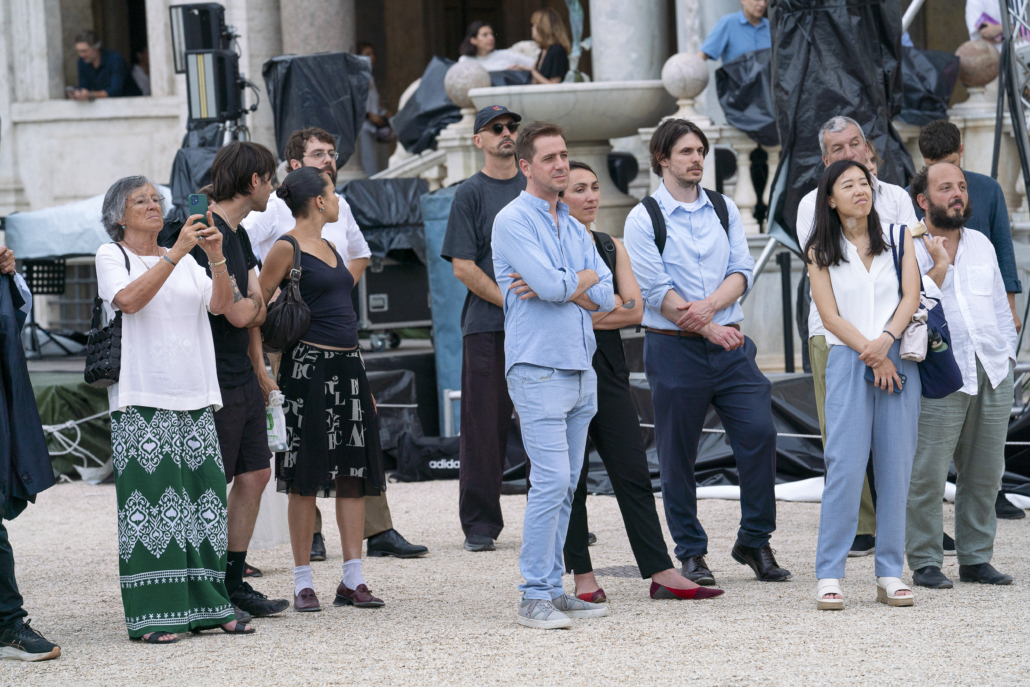
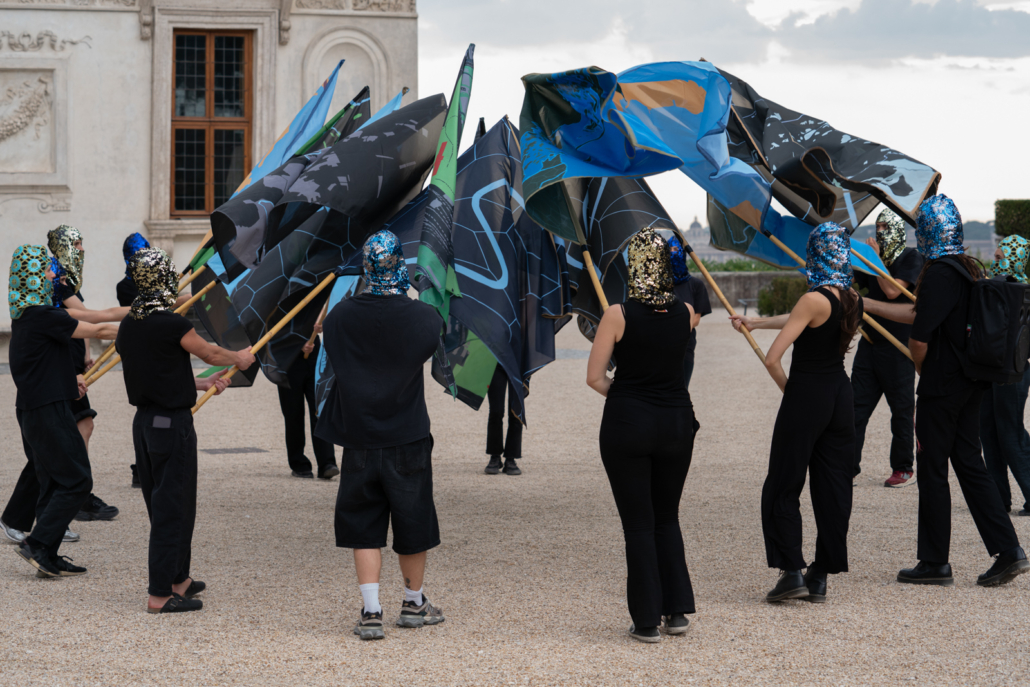
This advancing front carries a dual meaning: it represents the political force of territories claiming their right to exist while evoking the looming threat of extreme climate events capable of overwhelming cities, infrastructure, and communities. The conventional relationship between spectators and performers is overturned. Rather than passively observing nature, the audience is confronted by territories asserting their presence and occupying space. The performers then begin circling rapidly around the spectators, creating a moving ring that gradually tightens. Disoriented, the audience turns to follow the flags and bodies surrounding them. When the performers stop, facing inwards, some spectators find themselves inside the circle, others outside.
For a moment, the audience becomes part of the ritual, surrounded by the symbolic presence of the territories and subjected to their gaze. Human beings are no longer at the centre of the world but immersed in a wider ecological community upon which they depend.
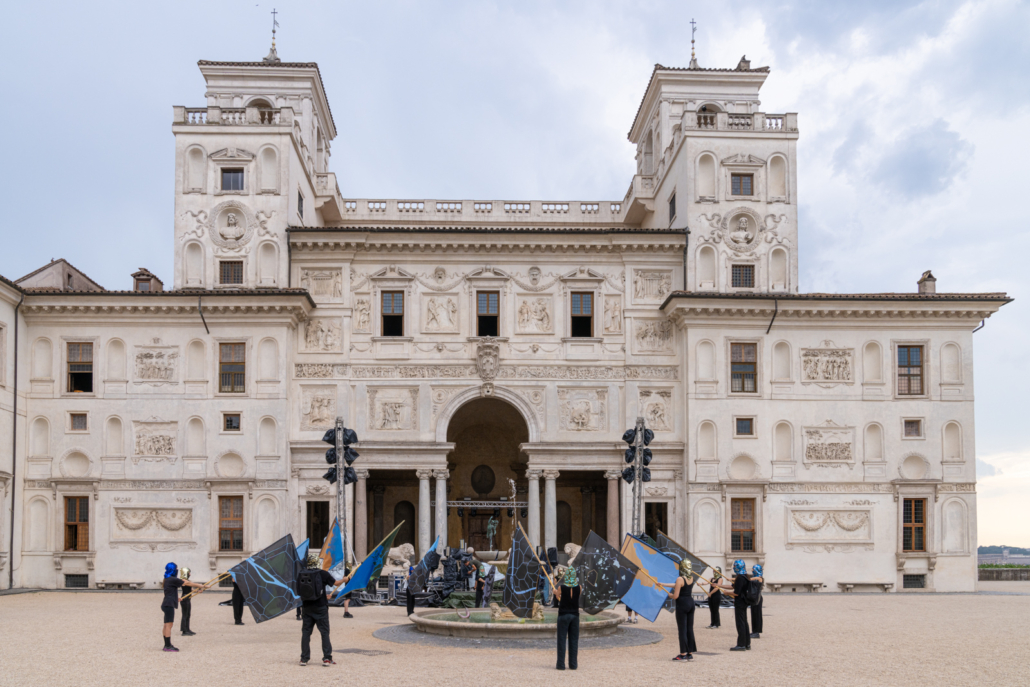
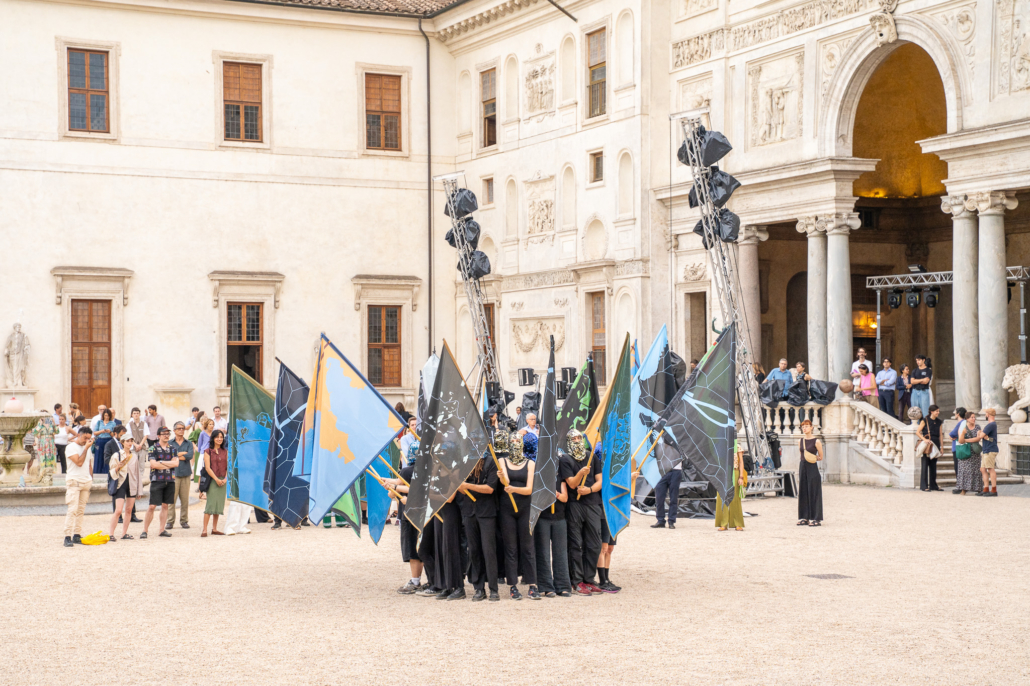
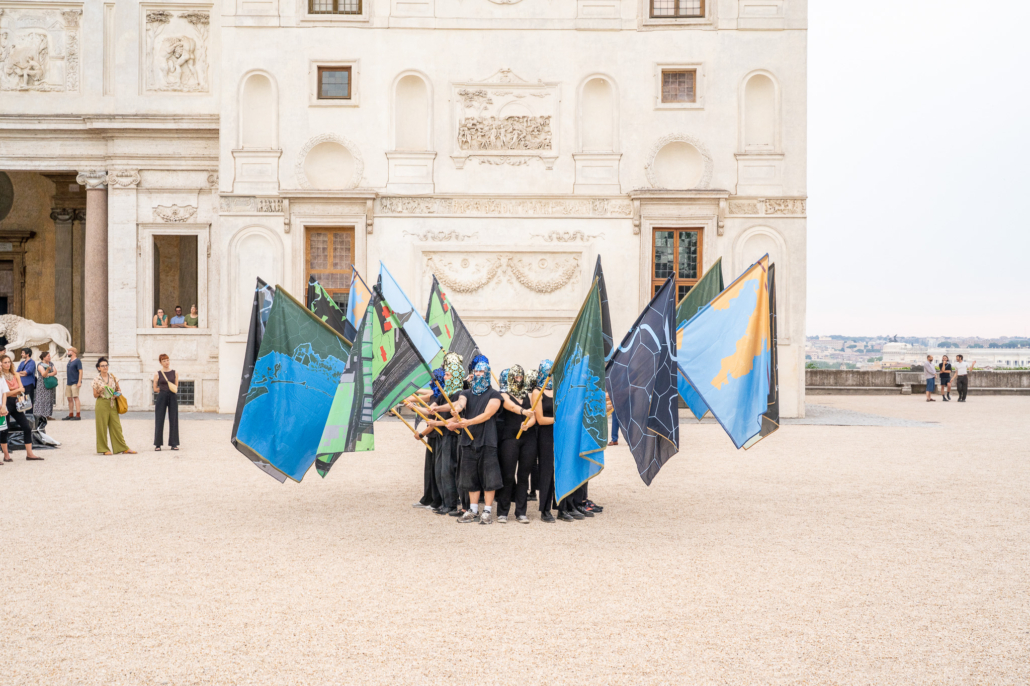
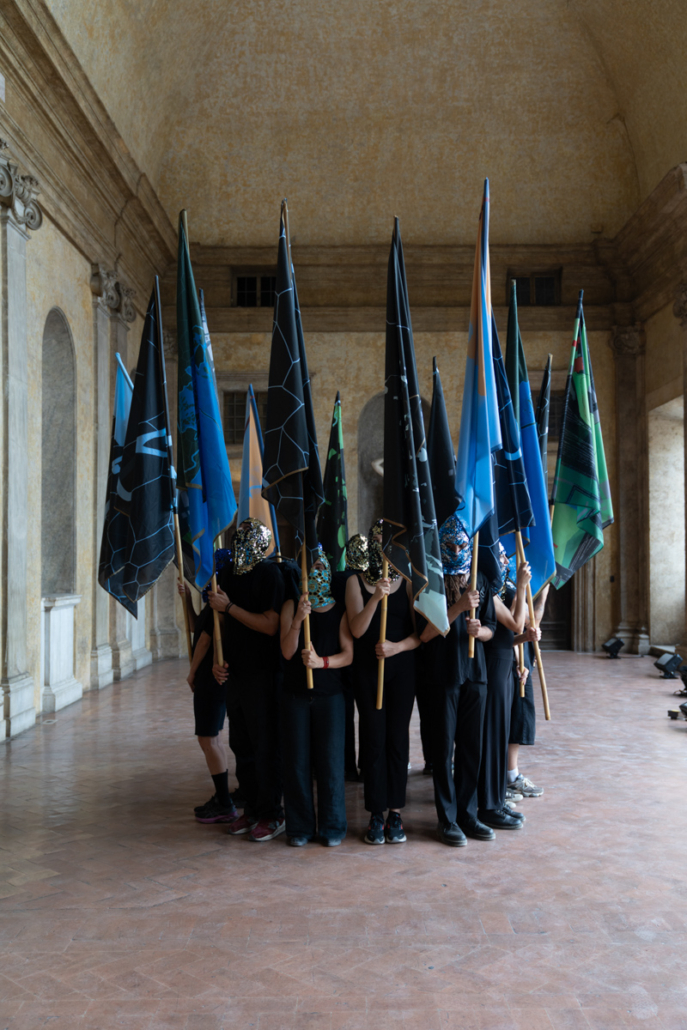
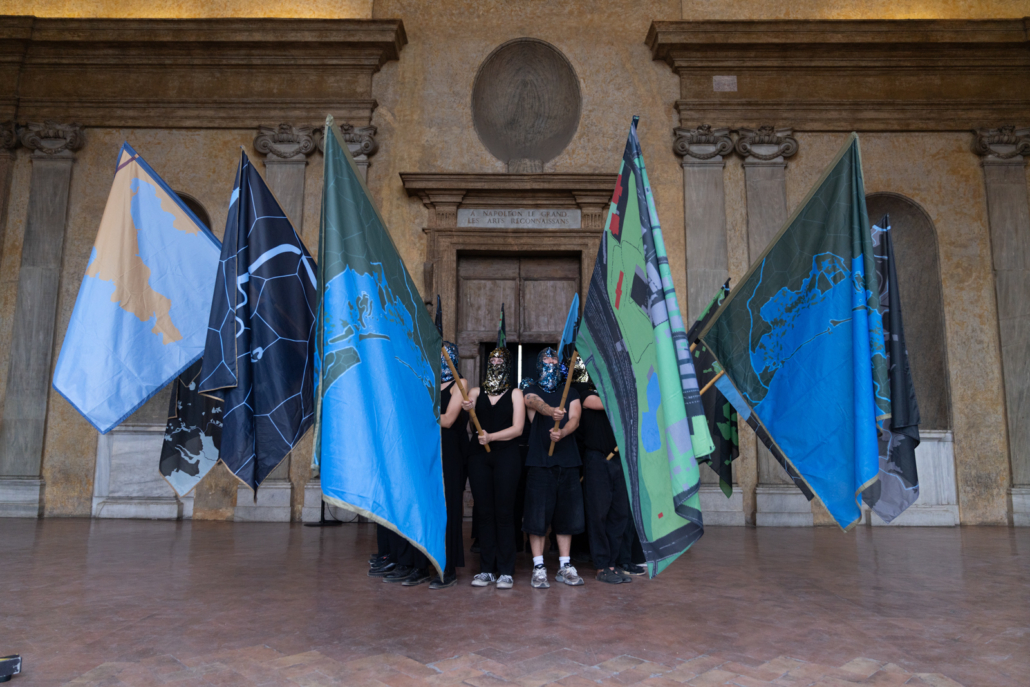
The performers then move through the audience towards the palace, entering its courtyard and symbolically occupying it through a collective flower-shaped formation. Each petal consists of a performer and their flag, representing a different ecosystem. The blue of the waters and the green of vegetation dominate this living figure, bringing together rivers, lakes, lagoons, forests, and parks. The Flower of Ecosystems represents the convergence of individual territorial struggles into a single collective organism: a planetary assembly of living communities temporarily occupying an institutional space. For several minutes, the performers gently sway, allowing the flags to flutter. Time seems suspended, creating a moment of contemplation, reflection, and political assertion. The flower appears to breathe slowly, like a superorganism composed of interconnected territories.
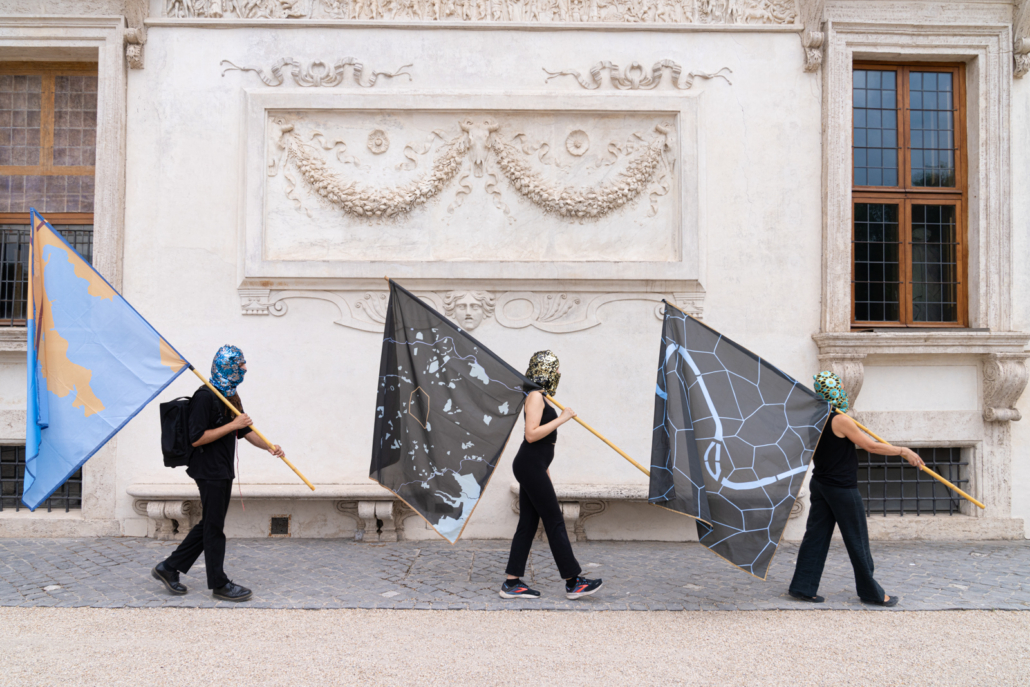
The symbolic occupation of Villa Medici becomes an act of more-than-human visual advocacy. Through the Flower of Ecosystems, territories bring their ecological claims into an institutional space. Rivers, lakes, forests, and lagoons are no longer passive landscapes but political subjects demanding recognition, representation, and the right to participate in decisions affecting their future. The flower eventually dissolves through a spiral movement, transforming into a single-file procession that crosses the audience and reaches the panoramic terrace of Villa Medici, overlooking central Rome. Here, the territories represented by the flags visually confront the urban landscape and its transformation through human activity. The procession finally returns towards the woodland. The performers cross the garden, disappear beyond the hedge, and re-enter the trees from which they originally emerged. The ritual ends with a return to vegetation, but not with a restoration of the initial condition. The experience has challenged established hierarchies between humanity and nature, inviting the audience to relinquish part of its anthropocentrism and recognize ecological interdependence. The parade is conceived as an initiatory ritual of ecocentric transformation, using bodily experience, tension, disorientation, and contemplation to propose a different relationship with the living world.
A ritual after which nothing should ever be quite the same.
The Looming Threat: From Climate Risk to Ecological Prevention
The performance also addresses the looming threat of climate risk: not only the destruction of ecosystems through human activity, but also the consequences that disrupted climatic balances produce for societies, cities, and all living beings. Floods, wildfires, heatwaves, storms, cyclones, droughts, desertification, storm surges, and coastal flooding pose growing risks to vulnerable territories, affecting human safety, infrastructure, economies, and ecosystems. As documented by the IPCC and the European Environment Agency’s European Climate Risk Assessment, climate change demands urgent measures of prevention, mitigation, and adaptation. Beyond physical and material damage, climate risks entail psychological and social consequences, including climate anxiety, fear of the future, feelings of powerlessness, and loss of attachment to places. These relationships between climate change and mental health are also recognized by the World Health Organization.
The wall of flags advancing towards the audience, followed by the encirclement, evokes this condition of vulnerability. Through bodily experience, the ritual makes perceptible a danger that often remains abstract or confined to scientific data.
Taking out insurance against climate disasters is not enough to ensure our safety.
Insurance can compensate for economic losses and support reconstruction, but it cannot prevent disasters, protect lives directly, or automatically restore destroyed ecosystems. Risk management must therefore go beyond financial compensation and address the conditions that generate and amplify vulnerability, as also discussed by EIOPA and the European Central Bank.
Collective and timely action requires reducing greenhouse gas emissions, accelerating a just transition to renewable energy, and investing in preventive measures, particularly green and blue ecological infrastructure, Nature-Based Solutions, and ecosystem restoration.
Urban reforestation, wetland restoration, river renaturalization, floodplain recovery, permeable soils, and ecological connectivity can reduce climate vulnerability while improving biodiversity, ecosystem health, and quality of life, as emphasized in the UNDRR–UNEP guide on Nature-Based Solutions for Disaster Risk Reduction.
These interventions must be complemented by circular and regenerative systems that reduce resource consumption, close material loops, and strengthen mutualistic relationships between human activities and natural processes. The response to the climate crisis cannot be merely individual, defensive, or emergency-driven. It must be collective, preventive, and transformative.
In this sense, the Flower of Ecosystems also symbolizes the possibility of transforming fear and powerlessness into cooperation and collective action.
From risk to prevention, from fear to action, from individual vulnerability to planetary ecological solidarity.
Flags as Archives of Territorial Struggles
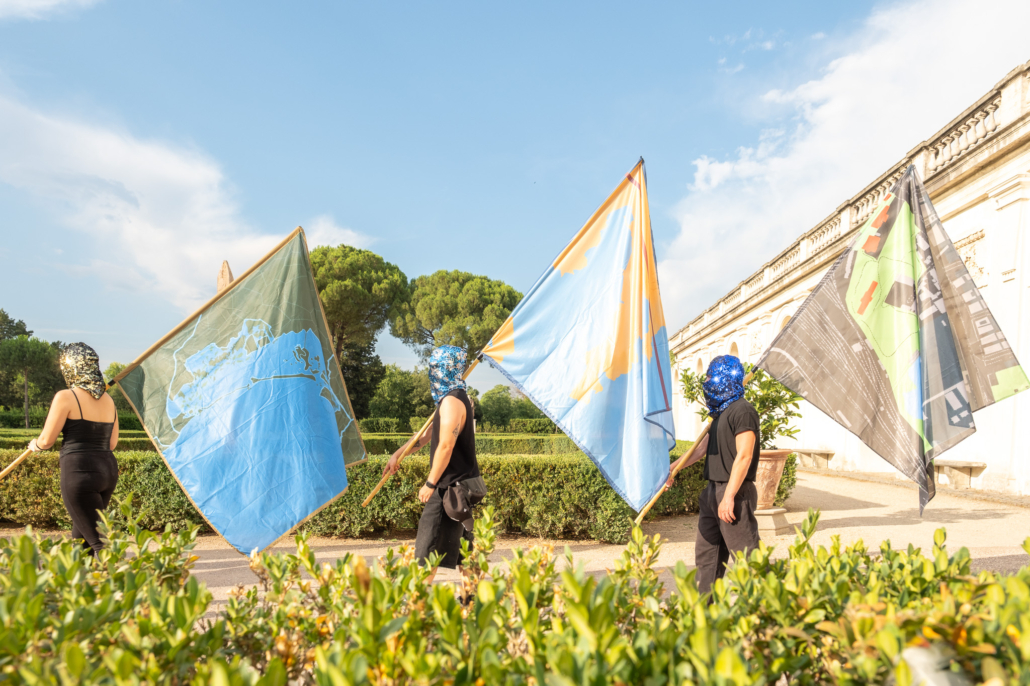
Each flag carries the memory of a specific ecological mobilization. Before coming together at Villa Medici, these flags travelled through cities, landscapes, demonstrations, and collective actions, connecting local struggles with planetary concerns.
The yellow and blue flag of Malta, used during Displacement Malta, created for the opening of the Malta Biennale 2024, represents the island’s sheltered coves and inlets, historically providing refuge for boats during storms.
The performance reclaimed the Mediterranean as a space of solidarity, passage, and freedom of movement, opposing border militarization and the criminalization of migration. Developed in dialogue with Friends of the Earth Malta and sea-rescue collectives, with whom a joint statement was prepared, it connected climate change, human mobility, and the right to rescue. These themes were also explored in the installation presented at the Malta Biennale.
The flag of Lago Bullicante, in Rome’s former SNIA industrial area, has accompanied grassroots demonstrations defending this spontaneously formed urban ecosystem, recognized as a Natural Monument after years of citizen mobilization. The struggle concerns its protection from real-estate speculation, the public acquisition of remaining privately owned areas, and the recognition of the lake and surrounding park as an accessible common good. This collaboration with local communities also led to Un Parco per il Clima — A Park for the Climate, a participatory ecological restoration project involving Green Classrooms around the lake and Parco delle Energie.
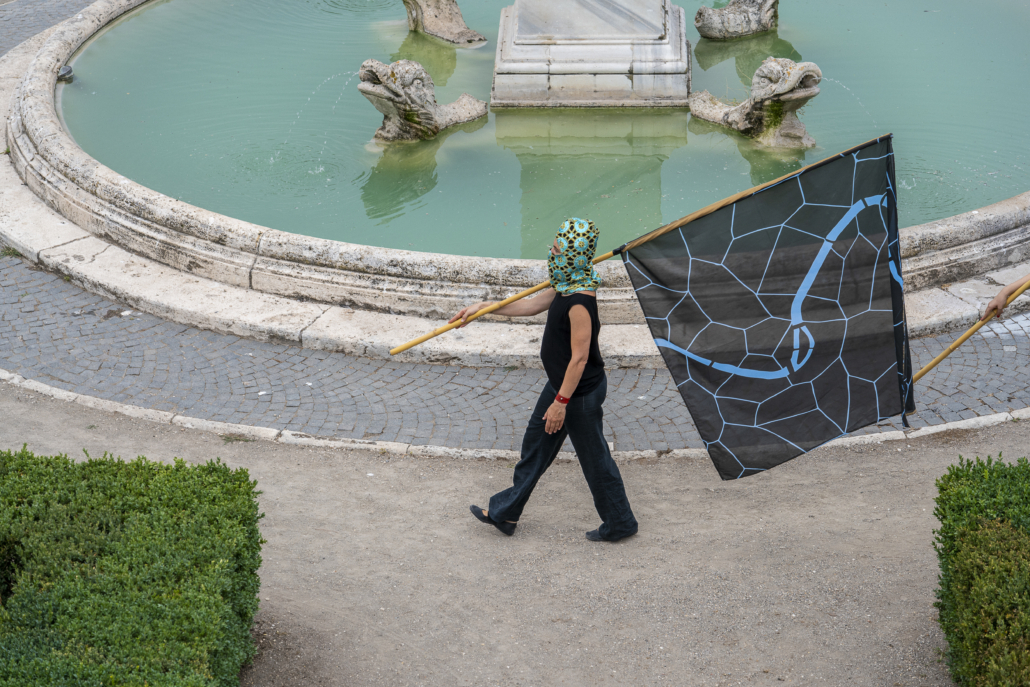
The flags of the Tiber and Aniene rivers, together with those of their river parks, have been used within FLUMEN – Climate Actions for Rivers and Parks, during the Parata Tiberina degli Inizi in January 2020, and in performative tree-planting activities at the Aniene Green Classroom.
These actions claim water quality, biodiversity, ecosystem continuity, and the health of river communities. This research continued with Be the River – Action for the River Tiber Rights, a 2025 performance in which performers embody the Tiber and symbolically claim its rights.
The flags of the Reno and Savena rivers, the Navile Canal, and Bologna’s hydrographic network and parks participated in Displacement, performed in Bologna in 2020. The work explored the relationships between water, climate change, and migration, addressing droughts, floods, desertification, sea-level rise, and the resulting global inequalities.
The flag of the Venetian Lagoon represents the lagoon as a living and vulnerable ecosystem, claiming protection against pollution, human pressures, and climate change. It was carried during Super-Symbiont, a collective performance for the Venice Climate Camp 2022, connecting with the earlier project Climate 04 – Sea Level Rise.
The flags of the non-human were also carried during the 2024 Climate Pride in Rome, as part of Super Symbiont – Walking Forest, developed with Climate Art Project, Lago Bullicante, Stalker, and other collectives. The parade affirmed a multispecies political alliance grounded in interspecies mutualism, an ecology of care, and planetary climate justice.
From Local Struggles to Planetary Visual Advocacy
Gathered at Villa Medici, these flags create a symbolic assembly of territories and ecosystems. Each struggle retains its geographical, ecological, and political specificity while becoming part of a shared planetary network. The defence of a lake, river, lagoon, or coastline contributes to a broader claim: the right of ecosystems to exist, regenerate, and escape the logics of exploitation and destruction.
The performance challenges an exclusively anthropocentric conception of politics, imagining forms of representation in which non-human beings, territories, and natural systems become political subjects. This approach resonates with Bruno Latour’s Down to Earth: Politics in the New Climatic Regime, which reconsiders politics through the ecological conditions of inhabiting the Earth.
Through symbols, bodies, and collective actions, artistic practice makes complex ecological issues visible, challenges dominant narratives, and creates images of alternative relationships between humanity and the living world. Imagination is not an escape from reality, but a critical and generative capacity to question what appears inevitable and envision new forms of coexistence and political representation. The performance proposes visual and conceptual advocacy: a form of symbolic and cultural pressure exercised through art in public and institutional spaces, addressing both society and policymakers. The flags of rivers, lakes, lagoons, and parks symbolically replace national and state flags, introducing subjects that generally lack autonomous political representation. Who represents a river’s interests? Who defends a lagoon’s ecological balance? Who brings the claims of ecosystems into the institutions where decisions concerning territories and environmental policies are made?
Through embodiment, the performance imagines a possible response: territories take bodily form, organize collectively, enter institutional spaces, and make their claims visible. This form of artistic advocacy can also be understood in relation to the Situationist legacy, through the temporary appropriation of public space and the disruption of established relationships between bodies, architecture, and collectivity.
This dimension resonates with Teresa Macrì’s analysis in Slittamenti della performance, Volume II, Anni 2000–2022, which includes Andreco among the artists examined. Macrì describes contemporary performance as moving beyond its comfort zone, from singularity towards plurality—a perspective closely related to the collective political bodies of ecological parades. Source: Inside Art, 2023.
Andreco’s ecological advocacy was already highlighted in 2019 by Sabina Minardi in Una parata ci salverà (A Parade Will Save Us), published in L’Espresso, ahead of the Parata Tiberina degli Inizi. The article explored the relationship between scientific research, symbolic artistic language, and environmental advocacy. Andreco described his intention to encourage a shift from an anthropocentric towards an ecocentric worldview through art.
The project also engages with T. J. Demos’s Decolonizing Nature: Contemporary Art and the Politics of Ecology, addressing the relationship between artistic practice, environmental justice, and political transformation. Artistic advocacy goes beyond denouncing existing problems. It uses imagination to make new forms of ecological coexistence, political representation, and collective agency conceivable. The performance calls for the recognition of the rights of nature, social and climate justice, biodiversity protection, and ecosystem health as central concerns in political and economic decision-making. It also advocates for concrete climate mitigation and adaptation policies, risk prevention, ecological restoration, and investment in green and blue infrastructure. This artistic practice does not replace scientific research or democratic institutions, but contributes to public debate and expands the horizon of political possibilities.
Before change can be realized, it must first become imaginable.
The flags of the non-human thus become instruments of an imaginary yet politically meaningful ecological diplomacy. They do not represent a state’s power over a territory, but the possibility that the territory itself might become a subject to be heard and included in decision-making. Art does not directly change laws, but it can help transform the collective imagination through which laws, policies, and institutions are conceived.
A Manifesto for Planetary Ecological Solidarity
More-than-Human Flags Parade is a statement against the extractive necropolitics of fossil-fuel economies, systems that sacrifice territories, ecosystems, and lives, and nationalist and repressive policies that turn borders into instruments of exclusion. The performance calls for overcoming the extractive logics of neoliberal capitalism and building a just ecological transition grounded in renewable energy, responsible resource use, ecosystem regeneration, and relationships of reciprocity, symbiosis, and mutualism between species. Human health cannot be separated from the health of rivers, forests, soils, waters, and other forms of life. Defending a territory means defending the very conditions that make life possible. The parade affirms an ecological, internationalist, and planetary solidarity that transcends national borders, ethnic identities, and hierarchies between species.
We do not carry the flags of territories to speak in their place. Through our bodies, the territories themselves enter the demonstration, take a stand, and claim their right to exist. From local struggles to a planetary claim. From the sovereignty of nations to the solidarity of all living beings.
Bibliographical and Theoretical References
Art, performance, and ecological thought
- Macrì, Teresa (2022). Slittamenti della performance, Vol. II: Anni 2000–2022. Postmedia Books. Bibliographical record · Review.
- Minardi, Sabina (2019). “Una parata ci salverà.” L’Espresso, 26 December 2019. Article on Climate Art Project.
- Haraway, Donna J. (2016). Staying with the Trouble: Making Kin in the Chthulucene. Duke University Press. Publisher.
- Demos, T. J. (2016). Decolonizing Nature: Contemporary Art and the Politics of Ecology. Sternberg Press. Publisher.
- Latour, Bruno (2018). Down to Earth: Politics in the New Climatic Regime. Polity Press. Author’s website.
Climate crisis, health, and risk prevention
- IPCC (2023). Climate Change 2023: Synthesis Report. Summary for Policymakers.
- European Environment Agency (2024). European Climate Risk Assessment. Report.
- World Health Organization (2022). Mental Health and Climate Change: Policy Brief. Publication.
- UNDRR–UNEP (2021). Nature-Based Solutions for Disaster Risk Reduction: Words into Action. Guide.
- EIOPA–European Central Bank (2024). Towards a European System for Natural Catastrophe Risk Management. Report.